

Gutter Drainage Solutions Denver homeowners can rely on should control water from the roof all the way to its final discharge point. The gutter collects the runoff, the downspout concentrates it, and the drainage system determines whether that water moves safely away or ends up exactly where the home does not need it.
A gutter can work perfectly at the roofline and still leave a homeowner with standing water, washed-out landscaping, icy concrete, wet window wells, or saturated soil beside the foundation. The gutter is only the beginning of the water-control system.
Most Homeowners Think the Downspout Solved the Problem
When water reaches the bottom of a downspout, most homeowners assume the gutter system has finished its job. Sometimes it has. But after decades of working around Denver homes, we can tell you the downspout is often only the halfway point. The real question is what happens to the water once it reaches the ground.
A downspout takes runoff collected across a large section of roof and concentrates all of it into one relatively small discharge area. During a fast Denver thunderstorm or a heavy snowmelt, that can be a surprising amount of water reaching the same corner of the property.
If the water moves away from the house, the system may be working correctly. If it sits beside the foundation, crosses concrete, washes through landscaping, reaches a window well, or enters a buried pipe that cannot discharge properly, the drainage system is incomplete.
If this is your first time hearing this, think of the entire system as one water path. The roof collects water. The gutter receives it. The downspout concentrates it. The ground-level drainage determines where it finally goes.
Page Guide
- Why gutter drainage systems fail
- Underground downspout drainage
- What poor drainage does around a home
- Drainage problems we see every week
- How Ernie’s Gutter follows the water
- Signs a drainage system is failing
Why Gutter Drainage Systems Fail
Gutter drainage systems fail when one part of the water path is overlooked. The gutter, downspout, underground pipe, property grade, and outlet all affect each other. Fixing one piece while ignoring the others can simply move the same water problem from one part of the yard to another.
Water Too Close to the Foundation
A short or missing downspout extension can concentrate roof runoff directly beside the home and keep the same soil saturated after every storm.
Poor Downspout Placement
A downspout can function properly but still be located where the water has no practical route away from the structure.
Blocked Underground Lines
Leaves, roof grit, roots, damaged pipe, ice, and restricted outlets can slow a buried drain until water starts backing up at the inlet.
Bad Drainage Pitch
Water does not travel uphill. Underground pipe needs usable fall so water continues moving toward its final discharge point.
Snow and Ice
Denver freeze-thaw cycles expose drainage systems that hold standing water. A line that works in summer can behave differently in winter.
No Reliable Exit Point
A pipe disappearing underground is not a complete drainage system unless somebody can explain where the water is supposed to come back out.
Poor Drainage Usually Means a Bigger Water-Control Problem
A wet area near a downspout should not automatically be treated as a landscaping problem. The water may have started two stories above the wet spot. A roof valley may be concentrating runoff. A gutter may be undersized. One downspout may be receiving too much roof area. The extension may be too short. Or an underground line may simply be unable to discharge the water being sent into it.
That is why we diagnose the system before deciding what to install. If the gutter is causing the problem, burying more pipe will not fix it. If a simple extension moves the water far enough away, there may be no reason to excavate. If underground drainage is needed, the inlet, route, slope, service access, and final outlet should be planned together.
Water Pooling Beside the House?
Let’s find out where the water is coming from before somebody starts digging.

What Poor Downspout Drainage Does to a Home
Water discharged in the wrong location rarely creates only one problem. It can soften soil beside the foundation, wash out landscaping, stain concrete, saturate basement window-well areas, and create winter ice where people walk.
In Denver, the same area can see rain, wet snow, warm afternoon snowmelt, and an overnight freeze within a short period of time. Water that was only inconvenient in the afternoon can become an ice problem after sunset.
Repeated saturation creates another problem. Homeowners may keep adding mulch, replacing decorative rock, filling low soil, or repairing the same landscape area without correcting the reason water keeps returning to that location.
The practical correction starts by controlling where the roof water lands.
Underground Downspout Drainage Near Me
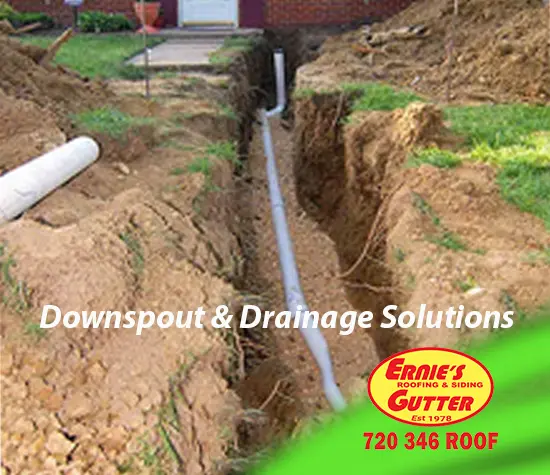
When homeowners search for underground downspout drainage near me, they are usually trying to solve a practical problem. A long surface extension may cross a walkway. It may interfere with mowing. The lot may be narrow. The house may sit close to a neighboring property. Or the natural grade may not provide an easy above-ground route away from the foundation.
Underground drainage can be an excellent solution when the property supports it. But putting pipe underground does not automatically make the drainage system better.
The outlet should be planned before the trench. We want to know where the water enters, what route the pipe will take, whether there is enough usable fall, how the system can be serviced, and where the water will finally leave the pipe.
A clean underground system should still make sense to the homeowner. You should know where the water enters, approximately where the line travels, how the system can be inspected or flushed, and where the water comes back out.
Drainage Receptors
A receptor can provide an accessible transition between the vertical downspout and the underground drain while keeping the inlet serviceable.
Cleanouts
Cleanouts provide access for inspection and maintenance instead of leaving the homeowner with a completely sealed underground mystery.
Pop-Up Emitters
A pop-up emitter releases water at a selected surface location. The surrounding grade still needs to carry the discharged water away.
Daylight Outlets
When the property has sufficient elevation change, a drainage line can terminate at a lower point where the water exits naturally above ground.
Gutter Drainage Problems We See Every Week
After serving Denver homeowners since 1978, certain drainage problems show up again and again. They are rarely caused by one dramatic event. Most develop because roof water has been discharged into the same bad location for years, an underground line was never planned correctly, or a simple gutter problem was allowed to become a ground-level drainage problem.
We see short extensions dumping water beside foundations, buried lines with no known outlet, downspouts feeding pipe that is too flat, water discharging across concrete, and gutter systems concentrating too much roof runoff into one downspout.
This is why a proper inspection matters. A quick trench estimate may only look at where pipe can be buried. A gutter and drainage inspection looks at the roof, gutter, outlet, downspout, property grade, and final discharge point so the correction addresses why the problem started.
Short Extensions
Water leaves the downspout only a foot or two from the home and repeatedly saturates the same foundation soil.
Water Across Concrete
A discharge path crossing a sidewalk or driveway becomes especially troublesome when snowmelt refreezes.
Unknown Buried Outlets
The downspout enters the ground, but nobody can identify where the water is supposed to come back out.
One Overloaded Downspout
The buried drain gets blamed even though the real problem is too much roof runoff being concentrated into one outlet.

How We Fix Gutter Drainage Problems
The correct repair depends on where the water problem actually starts. Sometimes a homeowner needs underground drainage. Sometimes a simple extension solves the problem. Sometimes the gutter itself needs correction before anything should be installed below ground.
- Inspect the roof-water source: We identify which roof areas and valleys are producing the runoff reaching the problem location.
- Inspect the gutter system: We check gutter condition, pitch, capacity, outlet locations, sagging sections, and overflow areas.
- Inspect the downspouts: We look at downspout size, placement, elbows, extensions, and existing underground connections.
- Read the property: We look at grade, lawns, landscaping, sidewalks, driveways, patios, window wells, and possible discharge locations.
- Choose the simplest complete correction: If an above-ground solution works, there is no reason to excavate simply to make the project larger.
- Confirm the drainage path: The goal is not simply getting water into a pipe. The goal is getting water away from the structure to an appropriate discharge location.
Not Sure Which Drainage System You Need?
An extension, underground line, gutter correction, catch basin, and French drain solve different problems. Start by identifying where the water originates and where it needs to go.
Signs Your Gutter Drainage System Is Failing
Drainage failure is not always a flooded basement or a lake in the backyard. Most systems give smaller warnings first. These are the signs Denver homeowners should not ignore.
Foundation Pooling
Water remains beside the home after surrounding areas have already begun drying.
Repeated Erosion
Soil, mulch, rock, or sod continually washes away below the same downspout.
Winter Ice
Water from a downspout repeatedly freezes across a sidewalk, driveway, porch, or front walk.
Drain Backup
Water rises around the downspout or underground inlet during heavier storms instead of disappearing into the line.
Wet Window Wells
Roof runoff repeatedly reaches basement window wells or other low areas beside the foundation.
Standing Water
The same area remains saturated after storms or snowmelt even when the gutter at the roofline appears to be working.
Why This Matters for Denver Homes
Denver weather keeps testing exterior water-control systems in different ways. Summer thunderstorms can move a large amount of water from a roof in only a few minutes. Hail and roof debris can restrict gutter outlets. Wet spring snow adds water gradually as it melts. Sunny winter afternoons can produce roof runoff while shaded soil remains frozen.
That is why gutter, downspout, extension, underground pipe, and surface drainage issues should be looked at as one system. When one component fails, another part of the property usually ends up dealing with the water.
That can mean wet fascia, damaged landscaping, saturated soil, slick concrete, wet window wells, or foundation moisture.
Ernie’s Gutter approaches drainage the same way we approach a gutter problem: follow the water first, then correct the reason it is going where it should not.
Sprinkler Company, Landscaper, Plumber, or Gutter Contractor?
This is one of the biggest areas of confusion for homeowners. A sprinkler contractor primarily works with irrigation. A landscaper may work with grading and landscape drainage. A plumber or licensed drain specialist may be required for certain regulated underground drainage work. A gutter contractor understands how water originates at the roof and becomes concentrated through the gutter and downspout system.
If the problem begins with roof runoff, the first inspection should include the gutter and downspout. Otherwise, a homeowner can spend money moving water underground without correcting why too much water was being delivered to that location in the first place.
Ernie’s Gutter evaluates the roof-to-ground portion of the system. If another specialty is genuinely the better contractor for a particular portion of the work, we would rather tell the homeowner that than pretend every drainage problem is solved by the same trade.
Downspout Drain or French Drain?
These terms get mixed together constantly, but they perform different jobs.
Downspout Drain: A downspout drain transports concentrated water that has already been collected by the roof, gutter, and downspout system.
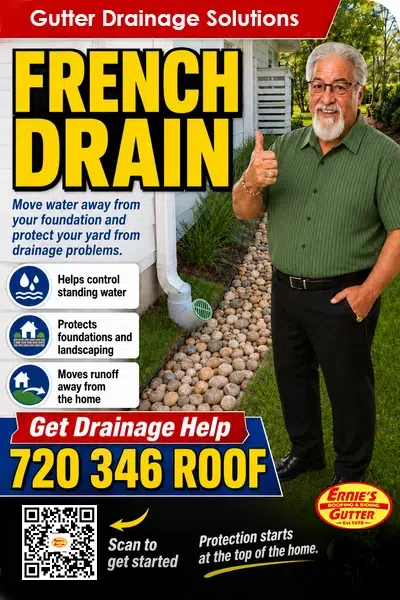
French Drain: A traditional French drain is primarily designed to collect groundwater or unwanted surface water through a gravel trench and perforated drainage pipe.
If the problem begins with a large volume of roof runoff coming directly from a downspout, installing a French drain simply because the word “drain” sounds correct can treat the wrong problem.
We first identify where the water comes from. Then we determine how it should be transported. Finally, we determine where it can safely discharge.
For groundwater and saturated-soil problems, see our French Drain Denver information.
Simple Drainage Checks Homeowners Can Do
Before calling anybody, walk around the property during a rain or shortly afterward when conditions are safe. You can learn a surprising amount simply by watching where the water goes.
- Watch every downspout and identify where the water exits.
- Check whether the ground slopes away from or back toward the home.
- Look for soil or mulch washing away below downspouts.
- Check basement window wells for standing water.
- Look for water crossing sidewalks, driveways, patios, or steps.
- Watch roof valleys and gutter corners for overflow.
- If a downspout enters the ground, determine whether you know where the line discharges.
- Look for crushed, disconnected, blocked, or obviously damaged drainage components.
Helpful Homeowner Resources
- Downspout Drainage Systems Denver — underground roof-runoff drainage planning.
- Downspout Extensions Denver — when an above-ground extension remains the simplest answer.
- French Drain Denver — groundwater, low areas, and saturated-soil drainage.
- Gutter Repair Denver — leaking, sagging, overflowing, and poorly draining gutter systems.
- Seamless Rain Gutter Denver — where the complete roof-water system begins.
- Gutter Companies in Denver — questions homeowners should ask before choosing a gutter contractor.
Frequently Asked Questions About Gutter Drainage Solutions Denver
What is a gutter drainage system?
A gutter drainage system controls roof water from the point it enters the gutter until it reaches an appropriate discharge location. Depending on the property, the system may include gutters, downspouts, extensions, receptors, solid underground pipe, catch basins, cleanouts, daylight outlets, or pop-up emitters.
Who should I call to bury a downspout in Denver?
If the problem starts with roof runoff, begin with a contractor who understands gutters, downspouts, and exterior drainage. The gutter system should be evaluated before deciding how the water should be routed underground.
Can Ernie’s Gutter install underground downspout drainage?
Ernie’s Gutter evaluates underground downspout drainage when the property has a practical route and an appropriate discharge location. The first step is determining whether underground drainage is actually necessary.
Do I automatically need underground drainage?
No. Some homes can be corrected with a longer extension, downspout relocation, gutter repair, or another above-ground solution. Excavation should be recommended because the property needs it, not simply because pipe can be buried.
What is the difference between a downspout drain and a French drain?
A downspout drain transports concentrated roof runoff that has already been collected by the gutter system. A traditional French drain collects groundwater or unwanted surface water through a permeable trench and perforated pipe.
What is a pop-up emitter?
A pop-up emitter is a surface outlet used with some underground drainage systems. Water flowing through the line raises the cap and allows the water to discharge onto the surface at the selected location.
What does daylighting a drainage pipe mean?
Daylighting means routing the pipe to a lower elevation where water can naturally exit above ground. A visible outlet also makes it easier to confirm that the system is flowing.
Can underground downspout drainage freeze in Denver?
Yes. Colorado freeze-thaw conditions are one reason slope, inlet design, standing water, and outlet location need to be considered carefully when planning underground drainage.
Why does my underground downspout drain back up?
Possible causes include debris, poor slope, damaged pipe, freezing, roots, an obstructed outlet, an undersized line, or a discharge point that cannot release water fast enough.
Who do I call for gutter drainage problems in Denver?
Call Ernie’s Gutter at 720 346 ROOF. We inspect the gutter, downspout, roof-runoff path, and ground-level drainage so you understand what is actually causing the problem before deciding what needs to be installed.
Gutter Drainage Problems Around Your Home?
Ernie’s Gutter has helped Denver-area homeowners diagnose gutter, downspout, and exterior drainage problems since 1978. We will follow the water, explain what is happening, and recommend the correction that makes sense for the property.
Move the Water Where It Belongs
Ernie’s Gutter provides gutter, downspout, and drainage solutions throughout Denver and the surrounding Front Range.
720 346 ROOF
Family owned Since 1978.
We Do it Seamless.
Protection starts at the top of the home.



OUR SERVICES
Best Gutter Installation
Get more information concerning our service, do not wait to call us at 720 346 ROOF today. We’ll be more than happy to schedule a meeting with you.

Residential Gutter Contractor
Ernie’s Gutter specializes in residential gutter installation in Denver and has a team of experienced professional gutter installers available to get the job done right The First Time. From minor repairs and maintenance to full–scale gutter replacements.

Commercial Gutter
Commercial gutter needs with ease. Our seamless gutters are made using only the highest quality materials and are built to last. With our custom fit, your new gutters will fit your project perfectly and look great!. Call us at 720 346 ROOF and book a consultation today.

Gutter Guards
Gutter guards come in a variety of materials, sizes, and colors so you can customize them to fit your home’s aesthetic. Gutter guards are designed to help keep the leaves from entering your gutters Hail Claim Help

Downspouts and Extensions
Downspout for Drainage is the place to go for all your system needs.We understand the importance of properly managing water runoff and are committed to ensuring that your home or business is protected from potential flooding or water damage.

Gutter Repair
When it comes to Gutter Repair, it can be difficult to determine whether the damage was caused by hail or wind or age. While all types of damage can cause similar symptoms, they have different causes and require different repair methods.
What’s New on The Blog
when should I change my roof?
Should I change my roof Not all roof coverings in roofing items coincide they educate themselves on what vacations they go on and also what sort of mobile phone they get but when it involves a roof that's not the case. Well, the older your roof it must be checked if...
Smooth gutter has been available in 35 tones in steel or light-weight…
Smooth gutter has been available in 35 tones in steel or light-weight lightweight aluminum. With the roof covering system you have plenty of alternatives to select from. Roofing covering specialist treatments containing brand-new roof treatments, re-roofs, framework...
You Tube – How To Extend The Life of Flat Roof Denver Carbon…
We are a 3rd generation service provider household had as well as run as well as take excellent satisfaction in offering our regional area. Providers are residence renovation service provider, smooth rain gutter as well as downspout specialist, roof covering...
#1 Rated Rain Gutter Contrator In Denver
Craftsmanship That Stands Like a House
Let’s Get Your Project on the Right Track

Let’s Get Started
Offering Gutter Replacement & Gutter Repair Near You