
Downspouts and Gutters Denver
Downspouts and gutters Denver homeowners rely on need a clear path from the roof edge to the discharge point. Ernie’s Gutter repairs, replaces, adds and reroutes downspouts, checks the outlets that feed them, and helps identify why water is overflowing or landing in the wrong place.
Family Owned Since 1978. Third-Generation Denver Gutter Experience.

Downspouts and Gutters Denver
Gutters collect roof runoff and direct it toward outlets. Downspouts then carry that water vertically to a safe discharge point. A good Denver gutter system is not just a trough attached to the fascia. It is a complete water-control path from the roof edge to the ground, and every part of that path has to work together.
If this is your first time hearing this, the most important idea is simple: a gutter can be perfectly straight, new and attractive and still perform poorly if the downspouts are undersized, badly placed, restricted, disconnected or dumping water too close to the foundation.
What Downspout Work Do You Need?
Repair What Is Damaged
Leaking joints, separated elbows, loose straps and crushed sections may need a focused repair. We check the outlet and surrounding gutter before recommending work so the same problem does not return after one damaged piece is changed.
Add, Replace or Reroute
An additional downspout, a larger outlet or a different route may help when the present layout cannot carry the roof runoff. A new vertical pipe still needs a workable outlet at the gutter and a suitable discharge location below.
Correct the Discharge
If water leaves the downspout freely but pools beside the house, the next decision is at ground level. An extension may be enough; buried drainage requires its own route, elevation and outlet assessment.
You do not need to diagnose the system before contacting us. Tell us where you see the water, whether it happens during heavy rain or snowmelt, and whether the affected pipe is loose, split, blocked or simply in the wrong location.
A Gutter Is Only One Part of the Drainage System
Homeowners often call us because they see water coming over the front of a gutter, dripping behind it or collecting at the bottom of a downspout. Those are visible symptoms, but the visible location is not always where the problem actually starts.
Water enters the system at the roof edge. From there, the gutter has to have enough capacity and enough usable slope to move that water toward an outlet. The outlet has to be properly sized and opened completely. The downspout has to receive the water without a restriction. Elbows have to change direction without creating unnecessary choke points. At the bottom, the discharge has to move water away from the home rather than simply dropping it at the foundation.
That is why Ernie's Gutter looks at gutters and downspouts as one connected system. Replacing one isolated piece without understanding what happens upstream and downstream can leave the original problem in place.
1. Collection
The gutter receives rain and snowmelt coming from the roof. Position, pitch and capacity determine whether water enters the gutter or overshoots it.
2. Transfer
Outlets and downspouts move the collected water from the gutter to ground level. Poor outlet placement or restricted downspouts can back water up quickly.
3. Discharge
Extensions, splash blocks or underground drainage move water away from the house. This final step is where many otherwise good gutter installations fail.
Find the Problem Before Choosing the Repair
Denver homes see a combination of sudden thunderstorms, hail, wind, snow, freeze-thaw cycles and periods of very dry weather. That means drainage problems do not always show themselves the same way year-round. A system may appear acceptable during a light rain and then fail when a summer storm releases a large amount of water in a short period.
Too Few Downspouts
A long gutter run with too few outlets has to carry more water farther before it can discharge. During heavier rain, the gutter may fill faster than the existing downspouts can empty it.
Downspouts in the Wrong Location
Downspouts should be positioned based on roof area, gutter direction, architectural conditions and where the water can safely terminate. Convenience alone should not determine placement.
Small or Restricted Outlets
The opening between the gutter and the downspout matters. If the outlet opening is undersized, partially covered or poorly cut, it can restrict flow before the water even enters the downspout.
Water Dumping at the Foundation
A downspout can move water perfectly and still create a drainage problem if it terminates immediately beside the house. The water needs a planned path away from the structure.
Loose Elbows and Connections
Downspout joints can separate from movement, impact, ice or poor fastening. Once a connection opens, water may discharge against siding, fascia, walkways or landscaping.
Gutters Holding Water
Standing water can point to slope problems, settlement, hanger movement or an outlet that is not draining correctly. A small amount after a storm is different from a long section that remains visibly full.
Not Sure Which Part Is Failing?
Tell us where the water appears. We can evaluate the connected gutter, outlet and downspout before recommending a correction.
Downspout Size, Outlet Size and Placement Must Agree
If this is your first time hearing this, a downspout’s size describes the cross-section of the pipe, not its height. Common rectangular residential profiles include 2-by-3-inch and 3-by-4-inch downspouts. The larger opening can provide more room for water and debris, but choosing it by appearance alone misses the important part: how much roof drains into that location.
When a Larger Downspout May Help
Large roof areas, concentrated valley runoff and heavy flow reaching one outlet can justify reviewing capacity. The gutter opening and transition must suit the pipe. Attaching a larger downspout beneath the same restricted opening leaves a bottleneck at the top.
When Another Outlet May Help
A long run may benefit from another discharge location when the gutter can be pitched toward it and the ground below provides a suitable destination. Adding a pipe to a high point in the gutter does not automatically make water flow toward that opening.
There is no reliable one-size-fits-every-house rule based only on gutter length. Roof area, roof shape, rainfall demand, gutter profile, outlet opening and the number of turns all affect the decision. We assess those conditions before recommending a size change; an overflowing gutter does not automatically mean every component needs replacement.
Residential and Commercial Downspouts
Commercial roof areas and building layouts can require a different capacity and attachment approach from a house. Access, wall construction, pedestrian routes and where concentrated runoff lands also matter. For a business property, tell us the building type and affected elevation; see our commercial gutter services for the broader system.
Downspout Placement Starts With the Roof and Ends at the Ground
We consider the roof area feeding each run, usable gutter pitch, corners, windows, doors, wall attachment and the discharge area below. Moving a downspout can shorten the water path but create another problem if it empties across a walkway or onto ground sloping toward the house.
The route should be considered before gutter fabrication. Appearance matters, but placing a pipe where it looks neat is not enough if water cannot reach it or leave safely.
Downspout Extensions, Splash Blocks and Underground Drainage
There is no single discharge method that is right for every Denver property. The correct solution depends on the grade around the house, available space, soil conditions, landscaping, sidewalks, driveways and where water can safely daylight.
Downspout Extensions
Above-ground extensions are straightforward, visible and easy to inspect. They can be effective when the ground slopes away from the home and there is enough room to move the water a useful distance.
Splash Blocks
Splash blocks help reduce erosion directly below a downspout, but they do not automatically solve poor grading. Their effectiveness depends on how the surrounding ground carries water away.
Buried Drainage
Underground drainage can keep the system cleaner visually and carry water farther from the foundation when designed with a dependable outlet and enough slope for drainage.
For buried pipe, drainage pits, yard runoff and difficult ground-level discharge, see our Gutter Drainage Solutions Denver page. Downspout repairs can often be evaluated without replacing the gutters or excavating the yard.
Where the Downspout Connects to Underground Drainage
A properly planned buried downspout line starts at the downspout transition, provides usable access for future service, maintains fall through the buried pipe and eventually reaches a final outlet where the water can leave the system.
Depending on the property, that outlet might be several feet away or much farther across the site. The distance is not what makes the system work. Elevation and a dependable final discharge are what make the system work.
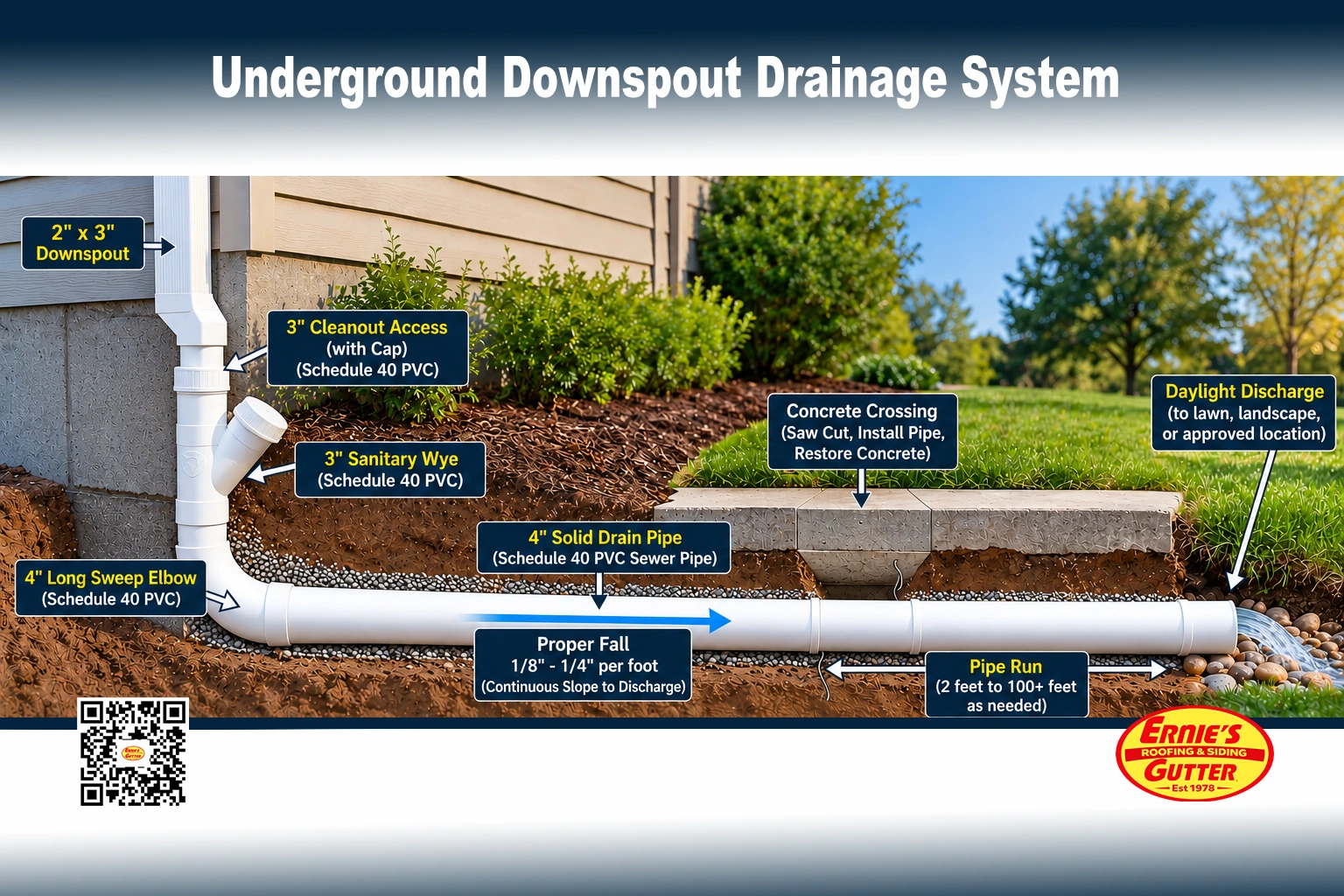
Illustration of a possible buried downspout connection, cleanout and daylight outlet. This is an explanatory diagram, not a photograph of a completed installation or a design for every property.
For suitable buried runs, solid 4-inch Schedule 40 PVC provides a smooth-wall route. The route still needs usable fall, service access and a dependable destination. A concrete crossing may involve cutting, excavation, pipe installation and restoration; those items need to be identified in the proposal rather than assumed to be included. Underground utility locations and outlet elevations must be checked before excavation.

“Before we put a saw in the concrete or dig the first foot of trench, I want to know where that water is going to come out.” The trench is only the route. If we have not figured out the final discharge, we have not designed the drainage system yet.
Denver Rain, Snowmelt and Freeze-Thaw Conditions
Short heavy storms can expose capacity problems that light rain never reveals. Snowmelt can refreeze where water remains trapped. After hail or wind, check for newly damaged sections and separated fittings from the ground.
Colorado Drainage Resources
For additional homeowner runoff guidance, see the City and County of Denver homeowner runoff guide. Denver's guidance discusses gutters, downspouts, foundation drainage and underground runoff management.
Colorado State University Extension also provides useful background on rooftop runoff, gutters and downspouts in its Colorado rainwater collection guidance.
Water Behind the Gutter Is Different From Water Over the Gutter
Homeowners often describe any gutter leak as an overflow, but where the water appears matters. Water coming over the front edge usually points us toward capacity, pitch, obstruction or outlet issues. Water appearing behind the gutter can involve the relationship between the roof edge, drip edge, gutter position and fascia.
The distinction matters because adding another downspout will not fix a roof-edge transition that is allowing water behind the gutter. In the same way, changing the gutter position will not solve a downspout that cannot move enough water.
A proper inspection follows the water path instead of assuming every symptom has the same cause.
Useful Checks You Can Make From the Ground
During rain, when safe, note where overflow begins and where water lands. Look for loose elbows, separated connections, new erosion, water marks and extensions that have moved. Check whether visible water returns toward the house after leaving the pipe.
Do not climb onto the roof or disconnect buried drains to diagnose the problem. Photos of the full downspout and its discharge area help explain the concern. Gutters, outlets, elbows and extensions still need periodic maintenance; a larger pipe or gutter guard does not eliminate it.
When Downspouts and Gutters Can Be Repaired and When Replacement Makes More Sense
Not every drainage problem requires a complete gutter replacement. A system with sound gutter runs may only need an outlet correction, an additional downspout, new elbows, a repaired connection or a better discharge route.
Repair becomes less practical when multiple problems are stacked together. For example, a long gutter run may have poor slope, damaged seams, loose attachment, undersized outlets and downspouts that terminate in bad locations. Correcting each defect individually can reach the point where replacing the affected system provides a cleaner and more predictable result.
Repair May Make Sense When
- The gutter itself is structurally sound
- A downspout connection has separated
- An outlet needs correction or enlargement
- A short section has a localized issue
- The discharge route can be corrected independently
Replacement May Make Sense When
- Several gutter sections are failing together
- Pitch problems exist across long runs
- Attachment points are repeatedly pulling away
- Old layouts do not provide enough usable outlets
- Repairing separate failures would rebuild most of the system anyway
For work specifically involving damaged existing systems, visit our Gutter Repair Denver page. For a system that has reached the point where replacement is the better scope, see Rain Gutter Replacement in Denver.
What We Check and What Your Proposal Should Explain
Follow the Water
We look at the gutter run, outlet, downspout, elbows, attachment and final discharge. A blockage, broken fitting and inadequate route call for different corrections. Tell us if the symptom appears only in a hard storm or also during ordinary rain.
Define the Affected Work
The proposal should identify the sections being repaired or replaced, the planned size and route, and whether outlets, elbows, straps and extensions are included. Removal, disposal, excavation and concrete restoration should be stated when they are part of the work.
Review Changes Before Extra Work
Concealed damage and buried-line conditions may require a revised scope. We explain additional work and its price before proceeding with that added work. A written scope helps you compare the correction being offered rather than a total without its details.
Downspout work is priced around the actual scope: height, access, material, length, fittings and connection conditions. A short elbow repair is a different job from rerouting a second-story downspout or connecting to underground drainage. We do not quote a universal repair price from a photograph alone.
Ernie’s Gutter is family owned, with third-generation experience serving Denver and the Front Range since 1978. Start with our Before Gutter Work Begins guide for questions about scope and approval. Check our service areas and include your city when requesting an evaluation.
Insurance Claim Support for Storm Damage
When hail, wind or impact damages gutters or downspouts, we can identify visible affected components and explain the proposed contractor repair scope. Coverage, deductibles and claim decisions belong to your insurance company. An older layout problem or maintenance issue should not automatically be described as storm damage.
Downspouts and Gutters: Frequently Asked Questions
Can you repair a downspout without replacing all the gutters?
Often, yes. If the gutter and its attachment are sound, a damaged elbow, separated connection, loose strap or short crushed section may be corrected on its own. We check the outlet and discharge route too, because replacing the visible damaged piece will not solve an upstream blockage or an unsuitable layout.
Do I need a 2-by-3-inch or a 3-by-4-inch downspout?
The choice depends on the roof area feeding the outlet, concentrated runoff, gutter capacity, outlet opening and downspout route. A larger pipe can offer more capacity, but it cannot correct every restriction. We evaluate the connected system rather than choosing a size from the gutter length alone.
Can adding another downspout stop gutter overflow?
Sometimes. Another outlet can shorten the distance water travels and provide another discharge path. The gutter must drain toward that outlet, and the ground below must offer a suitable destination. Blockages, poor gutter pitch and water overshooting the gutter need their own corrections.
Why does my gutter overflow only during heavy rain?
Heavy rain can reveal restricted outlets, clogged elbows, too few downspouts or limited gutter capacity. Concentrated runoff from a roof valley can also overwhelm one location. Note where the overflow starts and whether water reaches the downspout before assuming a larger gutter is the answer.
Can you move a downspout away from a walkway or driveway?
A route change may be possible after checking the roof outlet, gutter pitch, wall attachment and final discharge location. Moving the vertical pipe alone may introduce extra turns or leave water in another unsuitable place. Surface routing and underground options should be compared before the work is selected.
How far should a downspout discharge water from the house?
Far enough that the receiving ground carries water away instead of allowing it to return toward the foundation. The necessary route depends on slope, soil, available space and nearby buildings or walkways. An extension ending in a low spot is not effective merely because it reaches a particular distance.
Is underground drainage better than a surface extension?
Not automatically. A surface extension can be effective where the ground slopes away and the route is clear. Buried drainage is useful where surface routing is impractical, but it needs adequate fall, appropriate pipe, maintenance access and a suitable outlet. The property determines the appropriate approach.
Why is water coming out behind the gutter?
Water behind the gutter can involve the roof-edge transition, drip edge, gutter position or attachment area. That is different from water spilling over the front because of a restriction or capacity problem. A larger downspout will not repair a roof-edge detail that allows water behind the gutter.
Why does my downspout keep separating or splitting?
Misaligned fittings, loose attachment, impact or water freezing in a restricted section can contribute. Reconnecting the elbow or replacing the split section may be necessary, but the cause should be checked too. Otherwise movement, trapped water or poor alignment can damage the replacement in the same location.
What should I send when requesting downspout work?
Send your city, contact information, a short description of the problem and ground-level photos showing the gutter outlet, downspout and discharge area if available. Mention the story height, buried connection and when the problem occurs. Photos help explain the concern; the final scope and price depend on the actual conditions.
Get Help With Downspouts and Gutters Denver Problems
If water is overflowing, running behind the gutter, washing out landscaping, collecting beside the foundation or disappearing into a buried line that does not seem to drain, the first step is identifying where the system is losing control of the water.
For Downspouts and Gutters Denver problems, Ernie's Gutter can evaluate the gutter run, outlets, downspouts, elbows and final discharge route as one system. From there, the repair or replacement scope can be based on what is actually causing the problem instead of guessing at one visible component.
Disclaimer: General information on this page does not replace an on-site evaluation. Recommendations, sizing, scope and pricing depend on existing conditions, access and the proposed discharge route. Underground work requires utility and site review. Additional work must be approved before it proceeds. Insurance coverage is determined by the insurer. Gutters and downspouts require ongoing inspection and maintenance.