
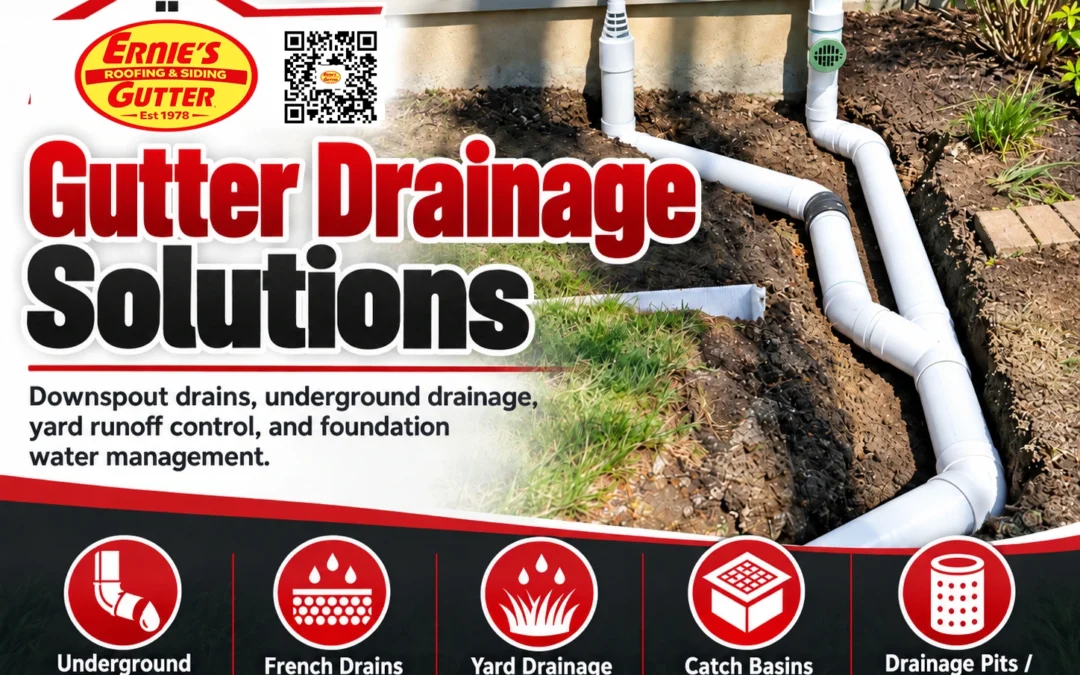
Gutter Drainage Solutions Denver
Gutter drainage solutions Denver homeowners need begin where the downspout reaches ground level. Ernie’s Gutter is a third-generation family contractor serving metro Denver since 1978. We diagnose buried downspout lines, short extensions, poor discharge locations, pooling, erosion, yard runoff and saturated soil instead of simply assuming the gutter itself needs replacement.
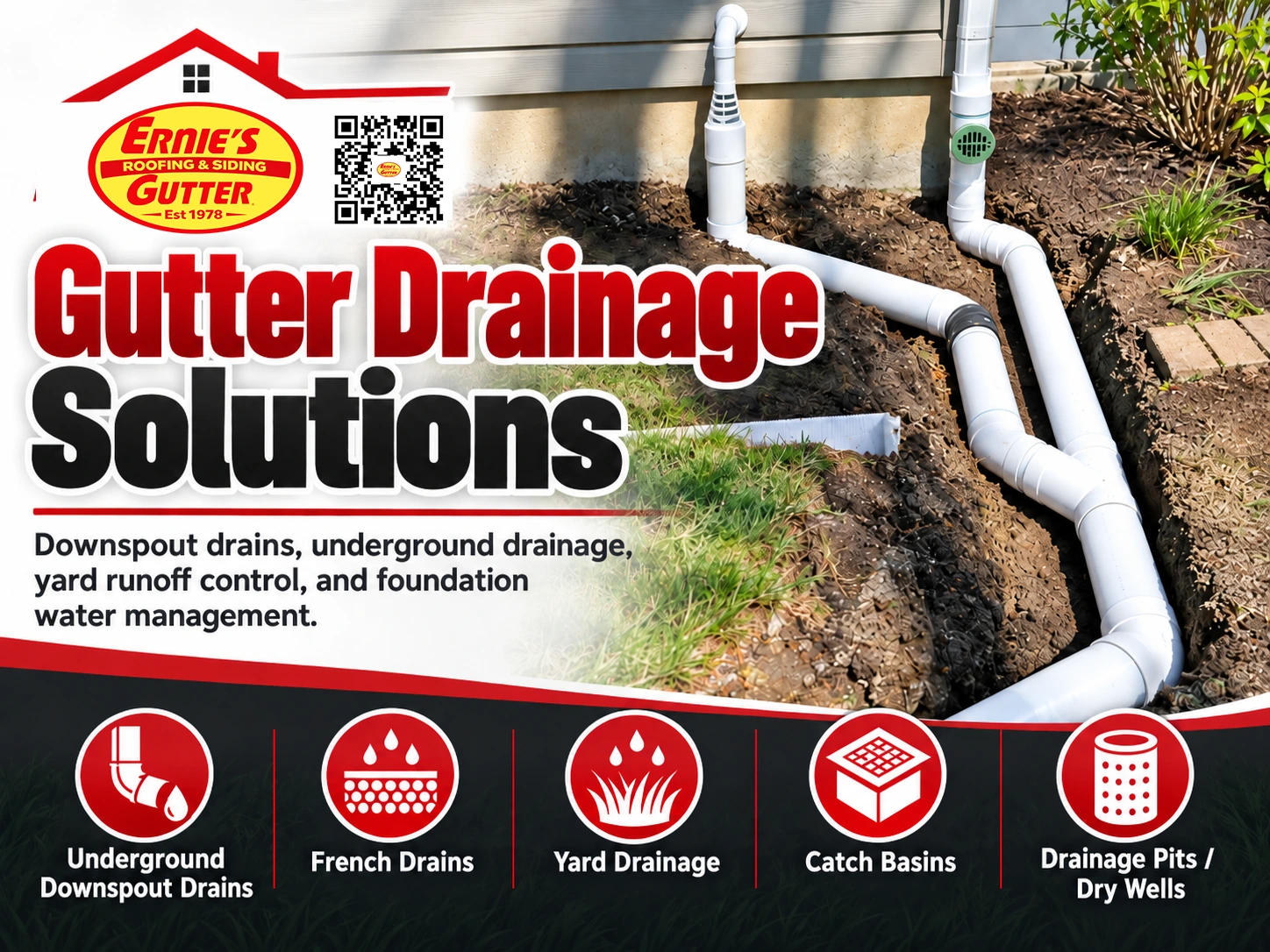
Gutter Drainage Solutions Denver for Roof Runoff, Groundwater and Yard Drainage
If this is your first time hearing this, drainage is not one single water problem. Roof runoff, surface runoff and water moving through saturated soil behave differently and often require different solutions.
The first question is not “What pipe should we install?” The first question is where the water originates, how it moves around the property and where it can safely finish.
Roof Runoff, Surface Water and Groundwater Are Different Problems
Roof Runoff
Gutters collect a large roof area and concentrate that water into individual downspouts. Once it reaches ground level, the water needs a controlled route away from the structure.
Surface Runoff
Surface water travels across yards, patios, driveways, walkways and landscaped areas. Low spots may require catch basins, grading corrections or dedicated surface collection.
Groundwater and Saturated Soil
Water moving through soil behaves differently from concentrated downspout flow. French drains and other subsurface collection systems are intended to intercept this moisture.
| Water Problem | Typical Solution | Main Job |
|---|---|---|
| Concentrated roof runoff | Solid 4-inch underground downspout drainage | Transport water away from the structure |
| Saturated soil or groundwater | French drain | Collect subsurface water |
| Surface low spot | Catch basin and solid outlet pipe | Collect surface runoff |
| Flat yard | Grading, collection and planned discharge | Create a workable drainage route |
| Limited gravity discharge | Drainage pit or dry well when appropriate | Controlled storage and infiltration |
One moves concentrated roof runoff from one location to another. The other collects unwanted water from surrounding soil. Understanding the difference is one of the most important parts of designing a drainage system that actually works.
Underground Downspout Drainage With 4-Inch Schedule 40 PVC
When a short downspout extension cannot reach a suitable drainage area, an underground line can provide a controlled route for roof runoff. Walkways, patios, concrete, landscaping and nearly flat ground all influence where that line can go.
Ernie’s Gutter commonly installs white 4-inch Schedule 40 PVC where the property and drainage conditions support it. Its rigid construction and smooth interior provide a durable, serviceable route for concentrated roof runoff.
Downspout Adapters
A properly sized adapter connects the rectangular downspout to the round drainage pipe. For a 2×3 downspout, the transition fitting must match that outlet and the underground line.
Cleanout Access
Accessible, capped cleanouts provide maintenance access to the buried line. The Denver project below includes cleanout access at each connected downspout and a vertical access riser at the drainage pit.
Long-Sweep Fittings
Long sweeps reduce abrupt changes in direction and help water and debris move through the system while improving future service access. Fittings are selected for the route and installation conditions.
Standing Water Between Houses — Existing Gutters Stayed in Place
This homeowner had standing water between the houses on nearly flat ground. Ernie’s Gutter installed an underground drainage route from the rear of the property toward a drainage pit at the front. No new gutters were installed: this was drainage work connected to the home’s existing gutter system.


- Main Line
- 4-inch Schedule 40 PVC
- Approximate Run
- 80 feet
- Installed Pitch
- ¼ inch per foot
- Maintenance
- Cleanout access
A Planned Route on Nearly Flat Ground
The approximately 80-foot line was installed at a pitch of ¼ inch per foot toward the front drainage pit. Across that distance, the pipe elevation drops approximately 20 inches. That fall is separate from the excavation depth.
Drainage Pit and Service Access
The pit measured approximately 5 feet across and 4 feet 6 inches deep. It was filled with layered drainage media including pea gravel, sand and river rock.
Each connected downspout has cleanout access. At the pit, a 2-inch vertical maintenance riser connects to the 4-inch line and is cut down to its finished height, keeping capped access available at the rock surface.
Drainage work does not require new gutters. This project addressed ground-level drainage while retaining the existing gutters. Ernie’s Gutter does not install pop-up emitters; the capped riser shown here is for maintenance access.
For an explanation of soil-water collection systems, see French drain installation Denver. This project documents a solid-pipe downspout drainage line leading to a drainage pit.
Underground pipe transports water; the receiving area still needs to suit the property. For roof-edge collection and downspout options, visit Downspouts and Gutters Denver.
Concrete Cutting and Hardscape Drainage Crossings
Denver homes often have sidewalks, patios and concrete directly between a downspout and the proper discharge area. In those situations, drainage work may require saw cutting, excavation and installation beneath or through the hardscape.
The important part is maintaining usable fall and a dependable outlet rather than simply getting a pipe underneath the concrete.
- Confirm underground utilities before excavation.
- Determine the final outlet elevation first.
- Maintain usable fall through the crossing.
- Protect the drainage pipe from loading.
- Preserve cleanout access where practical.
Why Flexible Corrugated Pipe Can Fail
Lightweight corrugated pipe is inexpensive and easy to install, but the ridged interior can retain sediment and the pipe can deform if it is poorly supported or subjected to loading.
That does not mean every corrugated drain is wrong. Pipe selection should match the route, depth, loading, water volume and service requirements.
French Drains for Saturated Soil and Groundwater
A French drain is a subsurface collection system. Its job is to intercept unwanted water moving through saturated soil rather than transport concentrated water directly from a downspout.
A typical French drain may include perforated pipe, washed stone and geotextile fabric. Water enters through the surrounding stone and perforated pipe and then moves toward an appropriate outlet.
Denver-area clay soils can retain moisture for long periods. When saturated soil is the real source of the drainage problem, a French drain may be appropriate.
For the specialist service page, visit French Drain Installation Denver.
Yard Drainage, Catch Basins and Surface Runoff
Some drainage problems exist independently of the gutter system. Surface water may collect because of low grading, surrounding hardscape, snowmelt or runoff moving across another portion of the property.
Catch Basins
Catch basins collect surface water at a predictable low point and route it into solid drainage pipe.
Grading Problems
Soil pitching toward the home can return water to the foundation even when the downspout itself is working correctly.
Flat Yards
Properties with little natural fall require careful elevation planning because very little height may exist between the collection point and final outlet.
See How to Drain a Yard With No Slope for the specific flat-yard drainage problem.
Drainage Pits and Dry Wells
A drainage pit or dry well can provide temporary storage and infiltration when gravity discharge is limited and surrounding soil conditions can accept the water.
Dry wells are not universal solutions. If the soil drains poorly, the pit can fill and remain full, leaving incoming runoff with nowhere to go.
Before recommending one, we consider the water source, expected volume, surrounding soil, nearby structures, available area and overflow path.
How Ernie’s Gutter Diagnoses a Drainage Problem
We follow the water before recommending a product. That helps prevent unnecessary excavation and separates simple downspout problems from larger surface or subsurface drainage conditions.
Identify the Water Source
Determine whether the water comes primarily from the roof, surface runoff, saturated soil or several sources at once.
Inspect the Gutter System
Check gutter capacity, outlets, downspout placement and concentrated roof runoff before blaming ground-level drainage.
Read the Property Grade
Review slopes, low areas, patios, concrete, landscaping, walkways and other obstacles affecting water movement.
Locate Final Discharge
Find a realistic outlet before designing the underground route.
Separate Collection From Transportation
Decide whether the property needs water collection, water transportation or both.
Choose the Simplest Complete Fix
The goal is not maximum excavation. It is the least complicated system that solves the complete drainage path.
Denver Clay, Snowmelt and Freeze-Thaw Affect Drainage
Gutter Drainage Solutions Denver has to account for very different seasonal conditions. Summer thunderstorms can send large amounts of roof runoff into one downspout quickly, while winter and spring snowmelt may release water when shaded soil and buried drainage areas remain cold.
Clay-heavy soil may absorb water slowly, and freeze-thaw cycles can expose low sections of buried pipe that hold standing water.
That is why pitch and final discharge matter just as much as pipe diameter.
The City and County of Denver also explains how rainfall, runoff, groundwater, slopes and soil conditions affect drainage around homes. See the City of Denver homeowner drainage and runoff guide.
Signs Your Home May Need a Drainage Evaluation
Water Beside the Foundation
Persistent moisture may indicate short discharge, poor grading, a clogged buried line or saturated soil.
Soil or Mulch Washing Away
Repeated erosion often means concentrated water is discharging with too much force in one area.
Buried Drain Backing Up
Bubbling near the downspout connection can indicate debris, poor slope, damaged pipe, freezing or a restricted outlet.
One Area Stays Wet
A yard section that stays saturated may indicate subsurface water or a persistent low point.
Ice Across Walkways
Poor discharge can create recurring winter icing where water crosses concrete or pedestrian areas.
Unknown Underground Outlet
If a downspout disappears underground and nobody knows where it ends, the system should not be assumed to be functioning correctly.
What Homeowners Can Document Before a Drainage Visit
A useful drainage evaluation starts with knowing when the problem happens. Does the wet area appear during rainfall, after snow melts, or several days after the weather clears? Take photographs from a safe location and note which downspouts are flowing at the time. A short video showing the direction of surface water can be more informative than a picture of a puddle after the storm has passed.
Look at the accessible end of an existing drain without opening or entering an excavation. Note whether the outlet is visible, covered by landscaping, or somewhere you cannot identify. Do not assume that a buried line reaches a working outlet simply because the downspout disappears underground. Give the contractor any previous installation records so the existing route can be evaluated before a replacement is proposed.
Ask What the Estimate Actually Includes
A drainage estimate should explain the proposed collection points, pipe route, materials, maintenance access and receiving area. Discuss what happens to excavated soil and how disturbed lawn, rock, mulch or concrete will be addressed. Surface restoration is part of planning the work, and the expected finish should be understood before excavation begins.
Ask how the proposed system will be checked and what maintenance it will need. If the receiving area is a drainage pit, discuss the soil conditions and what happens when incoming water exceeds the available storage or infiltration. The dimensions of a rock-filled excavation do not equal its usable water-storage capacity. Those questions matter more than an impressive pipe length or a large hole.
Keep a Record After Installation
Save photographs of the pipe before backfilling and note where cleanouts remain accessible. Keep caps visible rather than burying them beneath new landscaping. During later rain or snowmelt, observe the original problem area and the receiving area from a safe position. Report any backing up, unexpected pooling or erosion so the system can be evaluated. Project photographs document the installation; observations during actual runoff help document how it performs.
Helpful Homeowner Resources
Frequently Asked Questions About Gutter Drainage Solutions Denver
What is the difference between gutter drainage and yard drainage?
Gutter drainage manages concentrated roof runoff collected by gutters and downspouts. Yard drainage manages surface or subsurface water already moving through the property. Some homes need both.
What pipe does Ernie’s Gutter use for underground downspout drainage?
We commonly use white 4-inch Schedule 40 PVC where site conditions support it because it provides a rigid, smooth-interior and serviceable drainage route.
Can a downspout connect directly into a French drain?
Roof runoff and subsurface water should generally be evaluated separately. A solid downspout drain transports concentrated roof water, while a French drain collects water from surrounding soil.
What does a catch basin do?
A catch basin collects surface runoff at a defined low point and directs that water into solid drainage pipe.
Does Ernie’s Gutter install French drains?
Yes. We install French drains where saturated-soil or subsurface-water conditions make that type of collection system appropriate.
Do you install drainage pits or dry wells?
Yes, where site conditions support them. Soil infiltration, expected water volume, surrounding structures and overflow conditions need to be considered first.
Can you install underground drainage through concrete?
Yes, some installations require concrete cutting or hardscape crossings to reach a suitable discharge area. The drainage route still needs usable slope and a dependable outlet.
Why does my underground downspout drain back up?
Common causes include debris, sediment, roots, poor pitch, crushed pipe, separated fittings, freezing or a blocked final outlet.
Does every downspout need an underground drain?
No. If there is enough natural slope and a safe discharge location, a properly positioned above-ground extension may be simpler and easier to maintain.
How do you determine what drainage system my home needs?
We identify the water source, inspect the gutter and downspout system, evaluate grade and obstacles, locate a realistic final discharge point and then recommend the simplest complete solution.
Follow the Water Before You Dig
Gutter Drainage Solutions Denver should follow the complete water path. Good drainage is not simply buried pipe; it is a planned route from the source of the water to a dependable and serviceable final discharge point.
Schedule Drainage Evaluation#1 Rated Rain Gutter Contrator In Denver
Craftsmanship That Stands Like a House
Let’s Get Your Project on the Right Track

Let’s Get Started
Offering Gutter Replacement & Gutter Repair Near You