
ERNIE’S GUTTER · FAMILY OWNED SINCE 1978
Chop and Drop Seamless Gutters
Chop and Drop Seamless Gutters give you custom-length gutter runs while you or your crew handle installation. This guide explains what seamless fabrication changes, what it does not include, and how to prepare a project before ordering.
Featured Answer: Chop and drop seamless gutters are continuous metal gutter runs formed to specified lengths for a separate installer. They reduce joints along straight sections, but corners, end caps, outlets, and downspouts still require fitting. Good results depend on accurate measurements, compatible components, sound attachment, proper pitch, and a complete drainage plan.
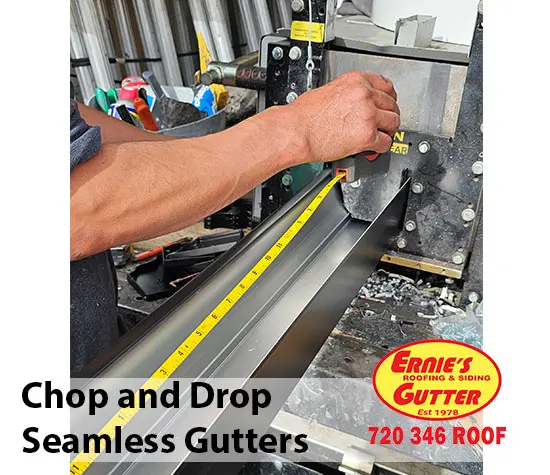
Chop and Drop Seamless Gutters
If this is your first time hearing this, seamless describes how a gutter run is made. Metal coil passes through a forming machine that shapes the material into a gutter profile. The run is cut to the required length. Instead of joining several short store-bought pieces along a straight roof edge, the installer starts with a continuous section measured for that part of the building.
Chop and drop describes the service arrangement. A fabricator supplies the gutter lengths, and installation is handled separately by the customer or an installation crew. Those two terms answer different questions. Seamless tells you about construction; chop and drop tells you who is doing which work. A complete installation can also use seamless gutters, with measurement, fabrication, attachment, and drainage connections handled within the installation scope.
These are still rain gutters. They collect roof runoff and direct it toward outlets and downspouts. The difference from sectional gutters is the reduced number of joints along straight runs. The difference from full-service installation is the division of responsibilities. Understanding both distinctions helps you request the right work instead of expecting a material order to include labor or drainage corrections that were never discussed.
Continuous straight runs
Custom lengths reduce intermediate joints along a roof edge. They still need suitable supports and carefully planned connections where the building changes direction or water leaves the channel.
Separate installation scope
Receiving fabricated gutter does not automatically include removal, fascia repairs, hanger installation, corner assembly, or downspout work. Confirm the responsibility for each item before ordering.
Project-specific planning
The correct gutter length is only one part of the job. Roof runoff, profile, outlets, downspouts, attachment surfaces, and final discharge all affect the finished system.
Ernie’s Gutter is a third-generation family business serving the Denver area since 1978. Our approach is to understand the job before producing a material list. For the service request, printable worksheets, existing color chart, and ordering details, use our Chop and Drop Gutter ordering page. This guide explains the decisions behind that order so the two pages serve different purposes.
Continuous does not mean the gutter should always be made in the longest possible piece. Access, handling, building geometry, and the selected product can affect a practical run length. Discuss unusual elevations and delivery routes before approving fabrication. A section that cannot be moved safely into position is not a useful order simply because it has fewer joints on paper.
Understand What You Are Buying
Chop and Drop Seamless Gutters can be a practical fit when you already have an installation plan and want professional fabrication. The value comes from receiving the agreed material without buying a gutter machine or assembling unnecessary straight-run joints. It does not mean that all labor disappears. Someone still needs to measure, handle the metal, install the system, and check where the collected water goes.
Compare the scope rather than the headline price
A material-and-fabrication quote and a full installation quote cover different work. Before deciding that one is cheaper, list what each proposal includes. Removal, disposal, replacement backing, fittings, downspouts, access equipment, and installation labor can change the comparison. If your own crew handles those items, their time and equipment still belong in the project budget even when they are not shown on the fabrication invoice.
There is no responsible blanket promise that doing the work yourself saves a fixed percentage. A simple accessible eave is different from a two-story wall with landscaping, a narrow side yard, and deteriorated fascia. Mistakes in finished length or color can also create replacement costs. Compare the measured scope and your available resources rather than choosing from a generic statement about eliminating labor.
Know which connections remain
Seamless gutters still have end caps, outlets, and corner connections. A building with several inside and outside corners may have substantial connection work even though its straight runs are continuous. Confirm whether you are receiving straight-cut sections or any additional fabrication. The installer must know which cuts, outlet openings, seals, and assemblies are still required before lifting the material into place.
Also separate the condition of the material from the performance of the completed installation. At receiving, check the agreed lengths, visible finish, and accessory quantities against the order. After installation, evaluate attachment, connections, and water movement. If a concern appears, record what you see before cutting, resealing, or replacing anything. Clear photos and the original paperwork help explain whether the question involves the supplied component, handling, or installation. Discuss the relevant product and workmanship terms instead of assuming that a general promise about seamless gutters covers every cause of a problem.
Specify the profile as well as the size
Our published service information includes 5-inch and 6-inch aluminum gutter options. Confirm the current profile, material, finish, and availability for your order. A nominal size alone does not identify every dimension or guarantee that a particular hanger, corner, or end cap will fit. Matching an existing gutter requires a closer comparison than looking at the decorative front from the ground.
Commercial box gutters require their own profile review. They should not be substituted into a residential order simply because both products collect water. The mounting details, outlets, supports, and roof area can be different. Read our seamless box gutter guide if the project calls for that shape, and confirm the actual product before ordering related fittings.
Plan Measurements, Corners, and Water Flow
A useful gutter drawing shows the building clearly enough that another person can understand the material request. Label each run and identify its location. Mark where a run stops, where it turns a corner, and where an outlet belongs. Do not replace that information with a single total-footage number. Two buildings can use the same gutter footage while needing very different fittings and downspout arrangements.
Distinguish field measurements from finished lengths
Write down what each dimension represents. A roof-edge measurement may not be the same as the finished cutting instruction once corners, end conditions, and joining methods are considered. Agree on any allowances before fabrication. Avoid mixing feet-and-inches notation with unexplained decimals. If several people are involved, make sure the person approving the order and the person installing it are using the same final drawing.
Measurements should be gathered with suitable access and equipment. Ground-level photos can help explain the roofline, but a photograph does not establish every dimension. Do not guess at an inaccessible section and present the guess as a verified cut length. If a measurement is missing, identify the gap and arrange appropriate help rather than risking a fall or producing material that does not fit.
Connect gutter capacity to the whole drainage route
Gutter size should be considered alongside the roof area feeding it, concentrated runoff, outlet openings, and downspout capacity. A larger channel will not automatically correct a blocked downspout or a discharge point that sends water toward the foundation. Likewise, a long roof valley can concentrate flow in a small area that deserves attention beyond the length of the gutter run.
Pitch is the slight fall that encourages water to move toward an outlet. The installer must plan it around the available roof edge and downspout locations. Do not apply one worksheet example as a universal rule for every roof. Building elevations and the selected gutter system influence the layout. The finished installation should collect and route water without copying the defects of an existing arrangement.
List compatible accessories
Include outlets, downspouts, elbows, straps, hangers, end caps, corners, and the specified sealant in the planning conversation. Identify which items are supplied and which your installer will provide. Gutters, outlets, and downspouts must connect correctly rather than merely have similar labels. Our downspouts and gutters information explains why the route continues beyond the channel at the roof edge.
Use the printable planning worksheets on the ordering page to organize these details. Their illustrations help identify components, but they are not a substitute for product-specific instructions or a project assessment. Confirm current contact information, materials, and quantities when reviewing the request with Ernie’s Gutter.
Prepare for Receiving and Installing the Runs
Long gutter sections need a receiving plan. Confirm where the fabrication or delivery vehicle can park, how the material will be supported, and who will move it. Look for gates, tight corners, overhead obstructions, uneven ground, and stored equipment that could affect access. Share those conditions before scheduling rather than discovering them when the finished metal is ready to unload.
Protect the profile and finish during handling
A continuous section can twist, bend, or crease when poorly supported. Do not assume that one person can safely handle a long run because the metal feels light. The practical handling method depends on length, access, weather, and the work location. Have enough help and suitable supports ready, and avoid dragging finished surfaces across rough ground or leaning them where vehicles or foot traffic can damage them.
Inspect backing before fastening new material
Fascia is the roof-edge board or finished mounting area behind the gutter. It needs suitable underlying support for the selected attachment method. New hangers cannot restore strength to deteriorated wood simply by being tightened harder. Water staining, loose old fasteners, and gutters pulling away from the wall are reasons to inspect the support conditions before attaching a replacement system.
Keep the installation responsibilities clear
Unless your written scope says otherwise, the separate installer handles secure attachment, alignment, corner assembly, outlets, downspouts, and final drainage checks. Ask which product instructions apply and whether the crew has experience with the selected profile. Treat unfamiliar height or access conditions as a reason to arrange qualified help rather than improvising with an unsuitable ladder or an unsupported section.
Once the system is installed, review the connections and discharge points using appropriate safe methods. Observing ordinary rain from a sheltered ground-level location can reveal water escaping at an outlet or pooling where a downspout ends. Keep photos and communicate any concern promptly. Seamless construction reduces certain joints, but it does not remove the need to check the complete installation or maintain it over time.
Choose Fabrication Only or Complete Installation
Chop and Drop Seamless Gutters make the most sense when the project has accurate dimensions, an agreed material list, a capable installation crew, and a practical handling plan. If those pieces are missing, complete installation may be the clearer choice. The question is who is equipped to finish the system properly, not whether a homeowner or contractor should always choose one arrangement.
Review these questions before approving material
- Who is responsible for the final lengths and any cutting allowances?
- Which profile, size, material, and finish have been confirmed?
- Are the required corners, outlets, hangers, and downspout parts included?
- Who will receive, support, and move the longest sections?
- Has the mounting surface been checked for suitable backing?
- Who handles installation, drainage review, and any necessary repairs?
Request clarification when an answer is uncertain. A fabrication quote should identify its own scope, and a separate installation agreement should identify the installer’s responsibilities. Confirm delivery arrangements, access charges, material availability, and any minimum order before scheduling. Product and workmanship warranty terms should also be discussed separately rather than assuming a material order includes an installed-system guarantee.
Maintenance still matters
Leaves, roof grit, seeds, and debris can obstruct seamless gutters just as they can obstruct sectional ones. Outlets and downspouts need attention because a restriction there can affect an otherwise clear gutter. Nearby trees, roof conditions, and site exposure influence maintenance needs. Plan safe access for future service rather than assuming that fewer joints eliminate cleaning or that an accessory will make the system maintenance-free.
The U.S. Department of Energy’s Building America guidance on gutters and downspouts explains the importance of moving roof runoff away from buildings. That principle applies regardless of who fabricates or installs the gutter. Use authoritative guidance, product instructions, and the conditions of the property together instead of selecting a system from a single generic sizing statement.
Helpful Homeowner Resources
- Chop and Drop Gutter service and order forms
- Complete seamless gutter installation
- Downspouts and drainage planning
- Commercial seamless box gutter profiles
- Gutter cleaning and maintenance
- Discuss your project with Ernie’s Gutter

Chop and Drop Seamless Gutters Questions
What are chop and drop seamless gutters?
They are continuous gutter runs fabricated to specified lengths for installation by the customer or a separate crew. Seamless describes the formed gutter construction; chop and drop describes the service arrangement. Confirm what materials, fittings, delivery, and fabrication steps are included before ordering.
Are seamless gutters still rain gutters?
Yes. They collect roof runoff and direct it toward outlets and downspouts. Seamless refers to continuous straight runs with fewer intermediate joints. The term does not describe a different purpose or remove the need for a complete drainage plan.
Do seamless gutters have any joints?
Yes. End caps, corners, outlets, and transitions still have connections. Continuous straight sections reduce certain joints, but correct fitting, sealing, support, and maintenance remain important to the performance of the installed system.
How is this different from full gutter installation?
Fabrication-only service supplies the agreed gutter material while installation is handled separately. A full installation scope may include measurement, forming, attachment, connections, and drainage review. Compare the written proposals because removal, repairs, fittings, and disposal can vary.
Can I install the gutter runs myself?
That depends on your experience, equipment, access, and the project. Long sections and work at height can require additional help and appropriate equipment. Fabrication-only service should not be treated as a promise that every gutter project is suitable for do-it-yourself installation.
Who provides the final measurements?
Agree on measurement responsibility before approving an order. Label each run, identify corners and end conditions, and distinguish field measurements from finished cut lengths. Any allowances should be confirmed for the selected connection method rather than assumed.
Which gutter sizes should I consider?
Ernie’s Gutter’s service information includes 5-inch and 6-inch aluminum options. Confirm the available profile and finish for your project. Roof runoff, outlet size, downspout capacity, and mounting conditions should guide selection rather than nominal size alone.
Will a larger gutter solve existing overflow?
Not automatically. Debris, blocked downspouts, limited outlet capacity, poor pitch, and concentrated roof runoff can also cause overflow. Identify the source of the problem before ordering larger material so the replacement addresses the actual restriction.
Do seamless gutters still need cleaning?
Yes. Leaves, seeds, roof grit, and debris can restrict the channel, outlets, or downspouts. Maintenance needs depend on the property. Fewer joints do not make the system maintenance-free or replace the need for safe access and periodic checks.
Where can I find the service request and printable order forms?
Use the Chop and Drop Gutter service page linked above for the planning worksheets, color chart, and ordering information. Contact Ernie’s Gutter to review the project and confirm scope, material, measurements, and scheduling before treating the request as an accepted order.
Protection Starts At The Top Of The Home
Disclaimer
Information on this page is provided for general education and project planning. Actual gutter sizing, fabrication, handling, attachment, outlet placement, downspout capacity, and drainage requirements depend on the property, product instructions, and applicable requirements. Confirm measurements, material availability, delivery arrangements, installation responsibilities, pricing, and warranty terms before approving work. Fabrication-only service does not include installation, removal, or repairs unless specifically agreed in writing.