
Third-Generation Family Contractor · Since 1978
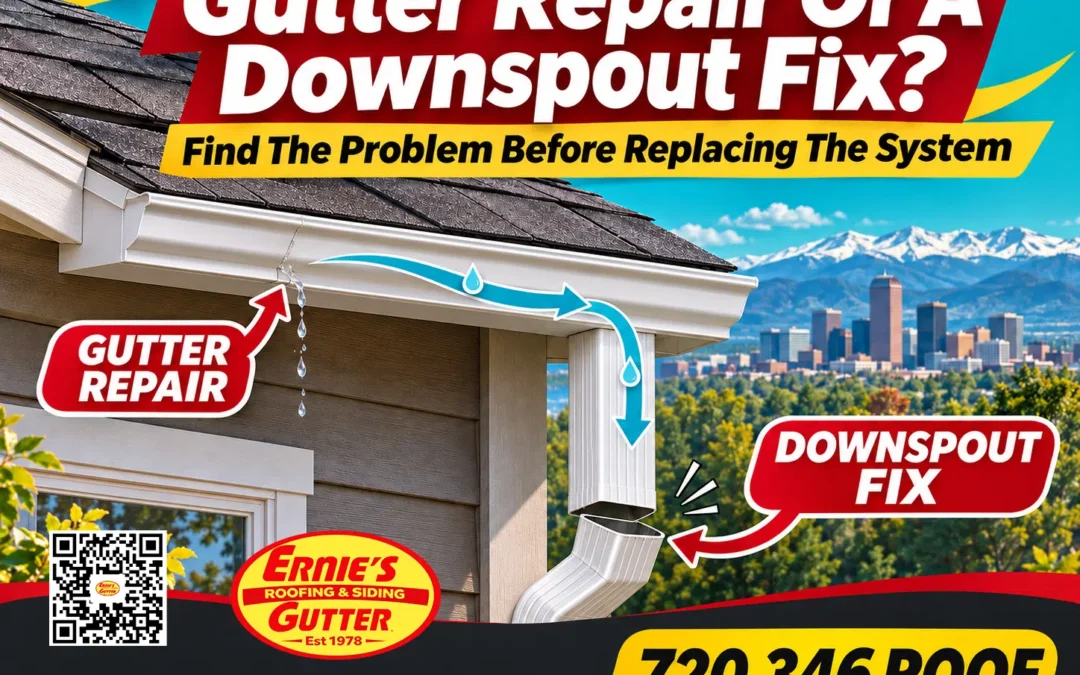
Gutter Repair or a Downspout Fix?
Water pouring over the gutter does not automatically mean you need new gutters
A downspout fix may be enough when the trouble is a separated elbow, damaged section or restricted connection. Other symptoms call for gutter repair or a ground-level drainage correction. Find where the water loses its path before approving a bigger job.

Gutter repair addresses failures in the collection channel, corners, pitch or attachment. A downspout fix addresses the outlet connection, vertical pipe, elbows or routing below it. Cleaning is appropriate for debris restrictions; ground-level drainage work addresses water after discharge. An evaluation should identify the failed part and explain whether a focused correction can preserve the rest.
Gutter Repair or a Downspout Fix: Start With the Symptom
You hear a splash outside the window. Water is hitting the siding, washing mulch onto the sidewalk or falling from a connection halfway down the wall. From the ground, everything looks like a gutter problem. The important decision is which part actually needs attention.
If this is your first time hearing this, gutters and downspouts perform different jobs. The gutter collects water along the roof edge. An outlet is the opening where that water leaves the gutter. The downspout carries it down the wall. An elbow changes its direction. The final extension or drain determines where it lands.
Those parts work together, but they do not always fail together. A loose bottom elbow does not prove that a sound gutter needs replacement. A gutter sagging between supports will not become properly pitched simply because someone installs a larger downspout. The proposed correction should follow the failure, not just the wettest spot.
Ernie’s Gutter is a third-generation, family-owned contractor serving Denver and the Front Range since 1978. Our aim is to explain the correction in plain language. You should understand what can stay, what needs work and why the recommendation fits your property before deciding how to proceed.
Follow the Water Before Replacing Parts
Start at the roof edge and follow the route toward the ground. Does runoff enter the gutter, or does it overshoot the front? Does the gutter carry water toward the outlet, or does water gather somewhere else? Does the downspout receive that flow and release it where intended?
These observations help separate problems that can look alike. Water spilling near the outlet could involve debris in the opening, a restricted elbow, limited capacity or a backed-up buried connection. Water appearing behind the gutter may involve the roof-edge transition or attachment area. Location gives you a starting point, not a diagnosis by itself.
Water Leaves a Joint
A separated elbow or failed connection may point toward a localized downspout fix. Check the surrounding alignment, attachment and flow before reconnecting it.
Water Sits in the Gutter
A low spot, shifted support or restricted outlet may require gutter repair. Removing leaves alone cannot restore the position of a sagging run.
Water Pools Below
If the pipe empties freely but water returns toward the house, examine the discharge route and surrounding grade. The vertical pipe may be doing its job.
Also note when the symptom appears. A connection that leaks during ordinary rain deserves a different investigation from runoff that overshoots one valley during a hard storm. Snowmelt can reveal a shaded restriction that was not obvious in warmer weather. Describe those patterns instead of trying to select replacement parts yourself.
When a Downspout Fix May Be Enough
A downspout fix can make sense when the trouble is limited to the pipe or its connections and the gutter above remains sound. Examples include a separated elbow, a crushed section, loose attachment or an extension that no longer directs water to a suitable receiving area.
The repair still needs more thought than pushing two pieces together. An elbow may keep separating because the sections are misaligned, the attachment is loose or movement is placing stress on the connection. Correcting that cause matters as much as replacing the visibly damaged fitting.
A split section also deserves investigation. Impact, material condition or trapped water freezing inside a restriction can contribute. A photograph can show the opening, but it usually cannot establish which cause applies. The right downspout fix depends on both the damage and what the connected system is doing.
Some homeowners ask whether one downspout can be added or moved. That may be practical when the gutter can drain toward the proposed outlet and the route below is workable. Moving the vertical pipe without checking pitch, wall details and discharge can simply move the problem to another location.
For the service details, visit Downspouts and Gutters Denver. That page covers additions, rerouting, sizing and how outlets connect to the rest of the system. This article helps you decide which concern to describe when requesting an evaluation.
When Gutter Repair Is the Better Starting Point
Gutter repair is more likely when the collection channel itself leaks, sags, pulls away or holds water because it no longer drains toward the outlet. Corners and end connections also need assessment when water escapes before it reaches the downspout.
A leaking corner should be checked for more than failed sealant. Standing water, movement or an unsupported section may keep stressing the joint. Covering the visible gap without addressing those conditions can leave the homeowner paying for another attempt at the same location.
Attachment deserves similar attention. Metal fascia covering is not a substitute for sound supporting material behind the fasteners. If that support is deteriorated or the connection is unsuitable, adding another fastener may not provide a dependable correction. The scope should identify supporting repairs when necessary.
That does not automatically mean replacing every gutter. A localized defect may be repairable while the remaining runs stay in place. Broader replacement becomes a separate discussion when several sections are failing, the layout needs extensive correction or the metal cannot reasonably support the proposed repair.
Our Gutter Repair Denver service page explains common repair categories. For an older system with widespread problems, the gutter replacement page provides a different scope. Ask why either option is being recommended rather than assuming replacement is always better.
One Damaged Connection Does Not Explain the Whole System
Tell us where the water appears and what has already been tried. We can evaluate whether the concern calls for cleaning, gutter repair, a downspout fix or a separate drainage correction.
Cleaning, Sizing and Repair Are Different Decisions
A downspout fix is not always a metal repair. Sometimes debris restricts an otherwise serviceable outlet or elbow. In that situation, clearing the restriction and checking the connected flow may be the appropriate starting point. Confirm whether the proposed cleaning includes attention to accessible downspout restrictions.
Clean gutters can still perform poorly. An outlet may be restricted by its opening, a run may slope away from it, or concentrated runoff may reach the gutter faster than the connected system can manage. Another cleaning does not correct every condition that produces overflow.
Likewise, a larger downspout is not a universal answer. A larger pipe below a small outlet leaves a restriction at the top. A larger gutter above a blocked pipe leaves a restriction below. Sizing should consider the roof area, valleys, gutter profile, usable pitch, outlets and discharge together.
Common residential rectangular sizes include 2-by-3-inch and 3-by-4-inch downspouts. Those measurements describe the pipe cross-section, not a guarantee of performance on a particular roof. Before approving a size change, ask what limitation the change addresses and whether the connected outlet and route will be corrected too.
A Working Downspout Can Still Leave Water in the Wrong Place
A downspout fix at the wall may not address pooling farther along the ground. An extension can move water beyond the bottom elbow, but its effectiveness depends on where it ends and how the receiving surface drains. Water can return toward the building if the surrounding grade carries it back.
Walkways, driveways, patios and neighboring buildings can limit the available route. An extension that creates a trip hazard or discharges across a frequently used path may need a different arrangement. Sending runoff toward another property is not a sound solution to a problem on your own.
A buried connection adds another part of the system to investigate. Water backing up at the transition could involve the buried line rather than the exposed downspout. Do not assume that replacing the visible pipe will clear a restriction or correct an unsuitable outlet farther away.
See Gutter Drainage Solutions Denver when the concern begins after water leaves the downspout. Persistent basement moisture, settlement or structural movement can require additional professional evaluation. Gutter observations are useful information; they are not enough to diagnose a foundation problem.
What Should a Focused Repair Proposal Explain?
Compare the proposed work before comparing totals. A downspout fix involving one accessible elbow is a different job from replacing a long second-story pipe, adding an outlet or excavating a buried connection. Access, fittings, material, removal and supporting conditions can change the scope.
A useful proposal identifies the affected location, what will be repaired or replaced, which connections are included and what remains. It should clarify whether cleaning, removal, disposal, fascia correction or ground-level drainage work is included. A short description can be clear without turning into a confusing parts catalog.
Our approximate access adjustment is 20% for affected second-story or steep-roof work where the pitch is greater than 5/12. It applies to affected work rather than automatically increasing every section on a mixed-height house. Applicable adjustments are included in the written proposal before work begins.
Hidden conditions need an approval path too. If supporting damage becomes apparent during the work, the additional correction and price should be explained before that extra work proceeds. Read Before Gutter Work Begins for questions that help clarify scope and approval.
For example, a proposal to reconnect one elbow should identify that connection. A proposal to add a downspout should identify the new outlet, pipe route and discharge arrangement. Those are different corrections, even if both are described casually as fixing a gutter leak.
Insurance Claim Support When Damage Follows a Storm
If hail, wind or impact visibly damages a gutter or downspout, we can describe the affected contractor work. Your insurer determines coverage and claim payment. A blocked elbow, aging connection or longstanding layout issue should not automatically be described as covered storm damage.
What You Can Check Safely Before Calling
You do not need to climb onto the roof to request gutter repair or a downspout fix. Ground-level observations can help explain the concern without putting you near a loose gutter or on a high ladder. Keep clear of falling sections, overhead wires and icy walking surfaces.
Take a wide photograph showing the roof edge, downspout and surrounding ground. Then, if it is safely visible, photograph the affected connection. A close-up alone may hide the route above or below it. Mention the story height and whether the downspout connects to a buried pipe.
Describe what you observe during ordinary rain, heavy rain or snowmelt. Do not recreate a problem by climbing with a hose or disconnecting an unfamiliar drain. If you already had cleaning or repairs completed, tell us what was done and whether it changed the symptom.
Homeowners sometimes wait until all the leaves fall before arranging service. That may be reasonable for routine seasonal debris, but active overflow, a loose section or a disconnected downspout deserves its own assessment. The timing should follow the condition and risk, not just the calendar.

Ernie Said
Do not cover a failing gutter. If the gutter leaks, sags, holds standing water, pulls away from the fascia or cannot handle roof runoff, correct that problem before installing protection.
Know What the Repair Changes and What It Leaves Alone
A focused correction should have a clear purpose. Reconnecting an elbow restores the intended connection at that location. Replacing a crushed pipe section restores the passage through that section. Correcting gutter pitch changes how water travels along the run. None of those descriptions automatically includes changing the ground slope or rebuilding a buried drainage line.
Before work starts, ask what improvement the contractor expects and which existing conditions will remain. If the proposed downspout fix leaves an older underground connection untouched, that boundary should be clear. If the gutter repair depends on correcting damaged support, understand whether that correction is included. Clear boundaries reduce the chance of mistaking a limited repair for a complete system redesign.
Afterward, keep the written scope and any supplied documentation. Observe the repaired area from the ground during suitable weather and note whether the original symptom returns. A different wet spot can indicate another condition elsewhere; it should be described and evaluated rather than automatically treated as proof that every part of the repair failed.
Helpful Homeowner Resources
Choose the service that matches the observed concern. Use our gutter repair information for leaking or unsupported runs and our downspout service information for pipe, elbow and outlet concerns. Ground-level water routing belongs with drainage solutions.
The City and County of Denver homeowner runoff guide discusses clogged gutters, downspouts and drainage around buildings. For background on systems connected to rain barrels, review Colorado State University Extension’s rainwater collection guidance. These resources explain broader water-management considerations.
When you contact Ernie’s Gutter, include your city and the specific symptom. Check our Denver-area service locations. You do not need to decide between a full replacement and a downspout fix yourself; the purpose of an evaluation is to explain that choice using the actual conditions.
Gutter Repair and Downspout Fix FAQs
Can a downspout fix solve gutter overflow?
It can when a restricted or damaged downspout connection is the cause. Overflow can also involve gutter pitch, outlet size, roof-valley concentration or a buried drain. The correction should follow an evaluation of the connected route, rather than assuming that a new pipe will solve every overflow.
Can you repair one downspout without replacing the gutters?
A focused repair may be practical when the existing gutter and supporting material are sound. A separated elbow, loose attachment or short damaged section may be addressed independently. The outlet, alignment and receiving area should still be checked so the same condition does not damage the repaired connection again.
How do I know whether I need cleaning or gutter repair?
Visible debris can indicate a maintenance need, but cleaning alone does not correct sagging, failed attachment, damaged metal or unsuitable pitch. Tell the contractor whether the system has been cleaned and whether the symptom changed. Ask what finding supports the recommended correction.
Why does my downspout elbow keep coming apart?
Possible causes include misalignment, loose attachment, impact or movement that stresses the fitting. Reconnecting the joint may be part of the repair, but the cause needs attention too. Repeated separation is a reason to evaluate the sections above and below the elbow.
Would a larger downspout be a better fix?
A larger downspout may help when capacity is the actual limitation and the gutter outlet and route support the change. It will not automatically correct debris, poor gutter pitch, a restricted opening or an unsuitable final discharge. Ask what problem the larger size is intended to solve.
Why does water still pool when I have a downspout extension?
The extension may end at a low spot or on a surface that sends water back toward the building. It may also be displaced or connected to an unsuitable drainage route. Once water leaves the downspout freely, the receiving ground and final destination deserve separate assessment.
Can a buried drain cause the downspout to back up?
Yes. A restricted buried line or unsuitable outlet can affect flow at the transition from the exposed downspout. Replacing the visible pipe may leave that condition unchanged. The buried route, maintenance access and final outlet should be considered before selecting a correction.
What affects the cost of gutter repair and a downspout fix?
Cost depends on the affected components, material, access, story height, fittings, removal, support and any separate drainage work. The written proposal should identify what is included, applicable access adjustments and how additional work will be approved. Comparing scope is more useful than comparing totals alone.
What photographs help you evaluate my gutter problem?
Send a wide ground-level view of the roof edge, downspout and discharge area, plus a closer photograph of the affected connection if safely visible. Include your city, story height, when the symptom occurs and any previous cleaning or repairs. Photos support the discussion; they do not replace an on-site evaluation.
Should I wait until all the leaves fall before requesting help?
For routine seasonal debris, timing can be discussed around the property and tree coverage. Active overflow, a detached section or a disconnected downspout should be evaluated on its own condition. Do not assume that waiting for the end of leaf fall is appropriate for an existing failure.
Find the Failed Part Before Approving the Job
Whether you need gutter repair, a downspout fix or a drainage correction, start with a clear explanation of the cause. Tell Ernie’s Gutter what you see, where it happens and what has already been tried.
Disclaimer: This article provides general homeowner information, not a property-specific diagnosis or quote. Repair recommendations, sizing, access adjustments and scope depend on actual conditions and the written proposal. Additional work requires approval. Persistent foundation, structural or underground-water concerns may require an appropriate specialist. Insurance coverage is determined by the insurer.